A scribe that follows the clinician
Helping clinicians capture documentation without returning to the workstation.
- Role
- UX Design
- Timeline
- June – July 2026
- Team
- Solo — individual exploration
- Skills
- UX DesignSystems ThinkingInteraction DesignClinical Workflow
Read this case study as
Challenge
How might AI documentation support doctors without disrupting the way they deliver care?
CARE is an open-source Hospital Information Management System (HIMS) developed by Open Healthcare Network. It helps hospitals manage patient registration, consultations, clinical documentation, and other healthcare workflows through a web-based platform.
To reduce the time doctors spend documenting consultations, the team was developing AI Scribe — an AI-powered assistant that listens to doctor–patient conversations and automatically generates structured clinical notes within the patient's encounter.
While AI Scribe significantly reduced manual typing, it was still fundamentally designed around a desktop workstation. During my exploration, I began questioning one of its core assumptions:
What if doctors aren't always near the computer?
The Problem
Doctors move. The workstation doesn't.
Clinical consultations rarely happen in one place. Doctors move between patients, equipment, assistants, and treatment areas depending on their specialty.
Yet documentation stays at the workstation. This disconnect forces clinicians to adapt their workflow to the technology instead of the other way around.
Design Question
What if documentation followed the doctor instead of the workstation?
The challenge wasn't simply improving speech recognition. It was rethinking how AI documentation fits into a clinician's consultation workflow.
How might documentation become accessible wherever patient care happens?
Perspective Shift
We weren't redesigning transcription. We were redesigning where and how documentation happens.
Exploration
Exploring hands-free documentation
As part of the Scribe initiative, the team explored voice documentation beyond the workstation.
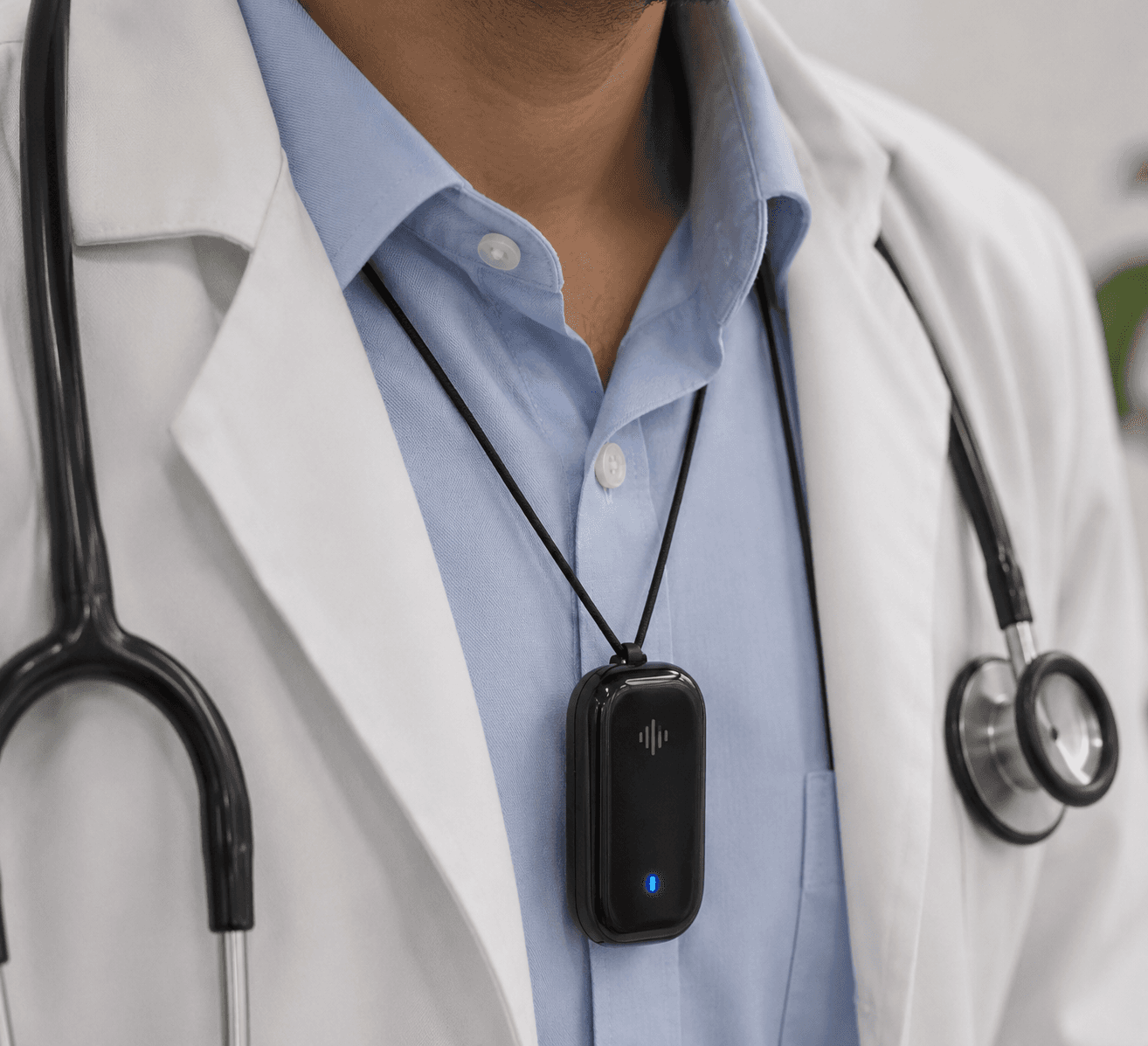
One concept was a wearable pendant microphone that streams doctor–patient conversations to AI Scribe, enabling hands-free documentation during consultations.
The exploration focused on how wearable technology could fit naturally into clinical workflows.
Questions that came up
As I explored this direction, I started asking practical questions.
Could the same workflow be supported using devices clinicians already carry every day?
What would it take to design, manufacture, and deploy a wearable device at scale?
How would maintaining, servicing, and replacing dedicated hardware affect long-term adoption?
What additional operational complexity would dedicated hardware introduce for healthcare organizations?
These weren't necessarily flaws in the wearable approach, but they highlighted the operational considerations that come with introducing dedicated hardware.
A different question
As I explored the wearable concept, my focus shifted from the interaction to the practicality of dedicated hardware.
Instead of asking
What new device should doctors carry?
I started asking
What device do doctors already carry?
That question changed the direction of my exploration.
I explored how clinicians' smartphones could extend AI documentation without introducing another device.
The goal wasn't to replace CARE Desktop—it was to extend documentation beyond the workstation.
Solution
After deciding to explore a mobile companion, I explored two ways it could fit into the existing CARE workflow.
Two directions we explored
Mobile as the documentation tool
- Consultation
- Record
- AI Transcribes
- Review & update clinical forms on mobile
Outcome
Mobile becomes another interface for completing clinical documentation.
Mobile as the capture companion
- Consultation
- Record
- AI Transcribes
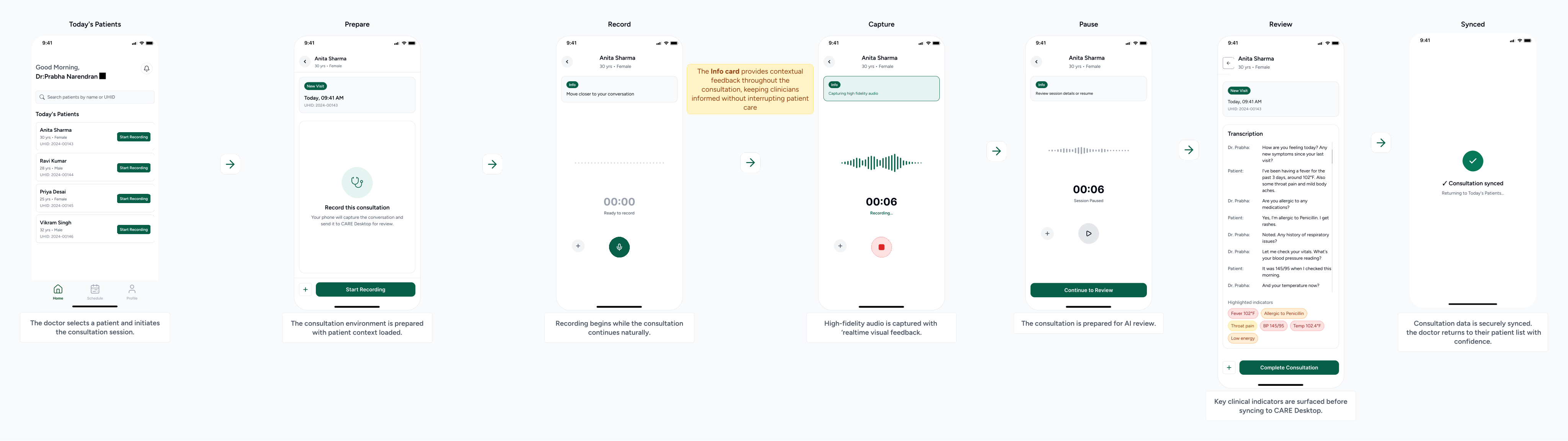
- Sync to CARE Desktop
- Doctor reviews and updates the encounter
Outcome
Mobile captures conversations at the point of care while CARE Desktop remains the place for reviewing and completing documentation.
Naturally, I chose the second direction — Mobile as the capture companion.
I chose the capture companion because the goal wasn't to recreate CARE on mobile, but to extend documentation beyond the workstation while keeping the existing desktop workflow intact.
The Mobile Companion Workflow
Beyond Voice Capture
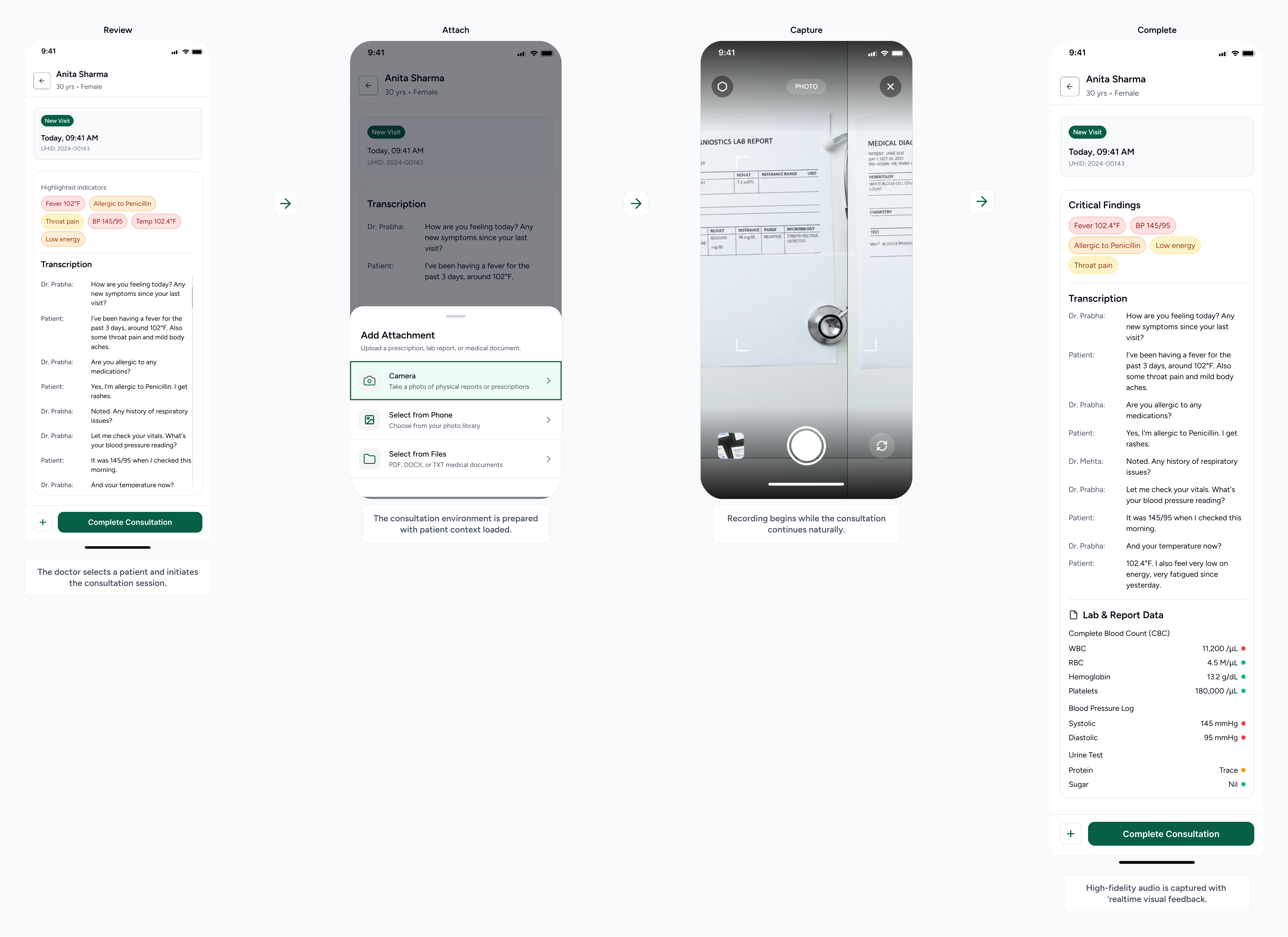
The same mobile companion can also capture clinical documents during the consultation. Instead of switching back to the workstation, clinicians can scan reports or handwritten notes and attach them directly to the encounter, where they're synced with CARE Desktop alongside the AI transcription.
Reflection
Thinking in Systems
Great experiences don't come from isolated features—they come from how those features fit into existing workflows, products, and mental models.
Design Around Workflows
The goal isn't to add another screen. It's to make technology support the clinician's workflow while staying out of the way.
This concept was proposed as part of my contributions to CARE as a Design Contributor and is currently under discussion with the CARE team.